Émily Winter – Trainee Social Media & Content
Émily moved to Berlin in 2018 to pursue a Bachelor’s degree in Cultural Studies, followed by a Master’s degree in European Media Studies at the University of Potsdam. During her studies, she focused extensively on media and memory culture, exploring how changes in the media landscape shape both collective and individual forms of remembrance. She gained practical experience in this field through her work as a student assistant at the Arolsen Archives, among other roles. Most recently, her Master’s thesis examined the use of AI in connection with contemporary witness testimony. She also explored different forms of media communication and design through artistic research projects. She is particularly interested in how complex historical and political topics can be translated into contemporary media formats without losing their complexity and ambiguity. Émily has been working as a Social Media & Content Trainee at the DDR Museum since August 2026.

What are your responsibilities as a Social Media & Content Trainee?
As I am still in the induction phase, I am gradually getting to know more areas of the role. So far, my main responsibilities have been monitoring and community management. This involves keeping track of comments, reviews and user reactions across various platforms, moderating them and responding where appropriate. My creative work also includes planning and producing content for our social media channels. For this, I take photos and videos in the exhibition and in the object collection at our depot in Marzahn, research and gather material from the object database, and cover various events that take place outside regular museum operations. These different responsibilities also give me an insight into other collaborative projects and topics that are relevant to the museum’s work and external communications. I work closely with the press team while also being in daily contact with the museum’s various other departments. It is precisely this combination of creative work, communication and insights into the museum’s different areas that I find particularly exciting.
What do you particularly enjoy about your job?
What I particularly enjoy is the variety, the creative freedom and the daily challenge of dealing with new and unexpected situations. The online world, and social media in particular, requires a very different approach to communication and interaction compared with face-to-face encounters. Although community management can sometimes be quite challenging, for example, I find it fascinating to observe how people interact on digital platforms. I am particularly interested in the question of how historical events, as well as everyday stories from the GDR, can be communicated through short and entertaining video formats. In doing so, I have to keep very different target audiences in mind, including many people who experienced the GDR themselves. As a young person who did not experience that period first-hand, this can sometimes be a particular challenge. At the same time, it allows me to learn a great deal and continually gain new perspectives on history. And ultimately, what makes my work especially enjoyable is the people I work with.
Do you have a personal connection to the GDR?
Born in Darmstadt with a French family background, I do not have a direct personal connection to the GDR. However, I spent many summer holidays on the island of Rügen as a child. When I later moved to Berlin, I ended up in the eastern part of the city. I have now lived in Friedrichshain for more than seven years and walk along Karl-Marx-Allee, with its monumental buildings in the Socialist Classicist style, almost every day. I also regularly pass the Samariterkirche, which was an important meeting place for the peace movement in the GDR and was known at the time for its Blues Masses. Today, particularly in summer, the square in front of the church is a lively meeting place where people gather in the evenings to talk and spend time together. I find it fascinating to learn more about the history of places like these and to observe how their present-day use places them in new contexts and gives them new meanings. During my Master’s degree at the University of Potsdam, I repeatedly engaged with the history and everyday culture of the GDR. In a seminar lasting several days, for example, we looked at DEFA films on the subject of »Women in the GDR« and discussed their cinematic representation. While developing and producing an audio walk about the Golmer Luch in Potsdam, I also learnt a great deal about waste disposal and landfill practices during the GDR period. Finally, another university project became particularly close to my heart. It was a fictional documentary short film about the artist Nina Hagen. Through this project, I realised just how many different ways there are of approaching GDR history, ranging from major political and social issues to very personal stories and everyday culture.
Which installation or area of the exhibition do you like best?
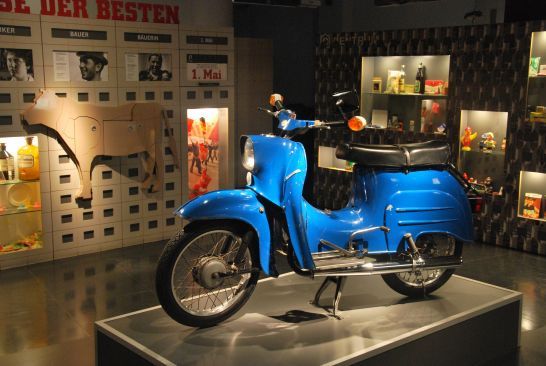
I enjoy walking through the reconstruction of the WBS 70 flat and sitting down at the listening station in the living room. I find it relaxing to simply sit there for a while, listen to the music and immerse myself in the musical world of the time. I enjoy researching the individual artists and the stories behind particular tracks and albums, and finding out how they were received in the GDR at the time. Given my academic background, I am naturally also interested in the section of the exhibition devoted to newspapers and magazines in the GDR. On my first visit to the exhibition, the »Street of the Best« also particularly stayed with me. I found it fascinating to see which professions were held in particularly high regard in the GDR and how social recognition and income varied depending on occupation, training and area of work.
If you could take one object from the DDR Museum collection home with you, what would it be?
The 1981 Amiga record by Janis Joplin. I am a huge Joplin fan and had no idea that her music was so popular among young people in the GDR. More generally, I find it fascinating to explore which Western musicians people listened to in the GDR and what their music meant to young people. Similar examples include Bob Dylan, who performed in Treptower Park in 1987, and Depeche Mode, who played in East Berlin in 1988.

What are your interests outside work?
In my free time, I like to be out and about and spend time with friends. I enjoy going to concerts, exhibitions and the cinema. I also do a lot of sport as a way to unwind. I play beach volleyball in both summer and winter, practise yoga regularly and enjoy trying out new sports. I like trying new things and meeting new people along the way, as well as discovering different perspectives.
How do you spend your lunch breaks?
My favourite thing to do is head out with my colleagues Nic or Liza and pick up something from the supermarket or the weekly market. When the weather is nice, you can also go for a walk around Museum Island. I enjoy doing that to get a bit of exercise and fresh air during the working day.
What book are you currently reading and why?
I recently started reading »The Anomaly« by Hervé Le Tellier. A friend gave me the book and I have been meaning to read more French literature again. Despite my French family background, it is something I have unfortunately neglected a little in recent years. As I am only at the beginning of the book, I cannot say too much about it yet. So far, though, the characters are wonderfully quirky and the opening is certainly promising, even if the writing style took a little getting used to at first.
If you had an extra hour each day, what would you do with it?
I would probably start playing the piano again. I would also like to spend more time doing creative things, making collages, drawing and simply experimenting with things that I often do not have enough time for in everyday life.
Which historical figure has left a lasting impression on you and why?
Singer and pianist Nina Simone. Her music has been part of my life for a long time, and I find it remarkable how she brought together personal experiences, social issues and political activism. For her, music was not just an art form. Above all, it was also a way of taking a stand and inspiring social change.